

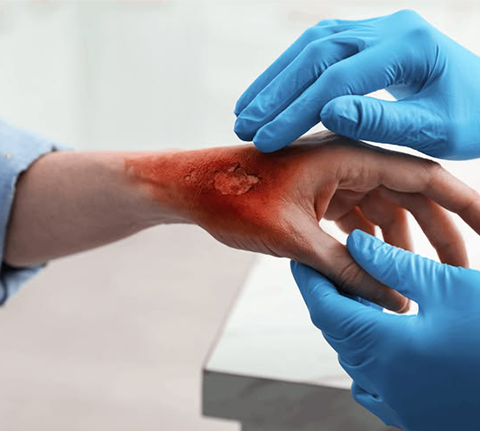
When a burn injury occurs, attention is often focused on the visible damage to the skin. However, what happens during the first minutes and hours after injury can significantly influence how the wound develops over time.
Burn wounds are not static injuries. They continue to evolve after the initial thermal insult, making early management an important factor in determining the healing environment and overall recovery trajectory.
Understanding early burn care is therefore essential—not only for immediate response, but also for supporting long-term wound stability.
Burn wounds continue to evolve after injury
Unlike many superficial skin injuries, burn wounds may continue to progress after the initial insult.
Residual heat, inflammation, impaired microcirculation, and tissue edema can contribute to ongoing tissue damage. This process, often referred to as burn wound progression, may increase the depth and complexity of the injury over time.
As a result, the condition observed immediately after injury may not fully represent the final extent of tissue damage.
This dynamic nature is one of the key reasons why early intervention is clinically important.
Common first-response mistakes
Despite increased awareness, several inappropriate first-aid practices are still commonly seen in burn injuries.
Applying household substances such as toothpaste, butter, or oils may trap heat within the tissue and interfere with proper wound assessment. These materials can also increase the risk of contamination.
Another frequent mistake is the application of ice or direct ice contact on the burn area. Extreme cold exposure may further damage already compromised tissue by reducing local blood flow and potentially worsening tissue injury.
In addition, disrupting blisters or removing damaged skin may increase the risk of infection and interfere with the natural protective barrier during early healing.
These actions are often well-intentioned but may negatively affect wound progression and overall recovery outcomes.
What early burn care should focus on
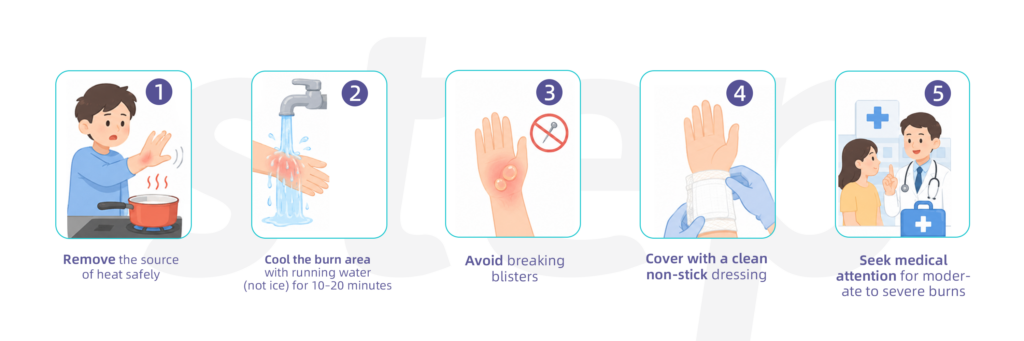
The first priority in early burn care is to stop the burning process and prevent further tissue damage. This begins with safely removing the source of heat and eliminating any ongoing exposure that could continue to injure the skin. Once the burn source has been removed, appropriate cooling can help limit burn progression and support early wound stabilization.
After this initial response, early burn care typically follows several practical steps that support wound protection and appropriate clinical assessment:
- Remove the source of heat safely
Move away from the heat source and carefully remove hot clothing or accessories that are not stuck to the skin. - Hold under cool water
Cool the affected area under cool running water to help dissipate residual heat and reduce ongoing tissue damage. - Bandage up
Lightly cover the wound with a clean or sterile dressing to protect the injured area from external contamination. - Make a cold compress
A cool compress may be used as a supportive measure for pain and swelling relief, avoiding direct ice contact with the wound. - Consult a doctor
Seek medical evaluation for large, deep, or high-risk burns, or whenever there is uncertainty regarding burn severity.
These steps are not intended to replace professional medical treatment, but to support early stabilization before further clinical evaluation.
Early care sets the foundation for healing
Early burn care does not directly heal the wound. Instead, it helps establish the conditions under which healing can occur in a controlled and predictable manner.
By limiting additional tissue damage, protecting the wound environment, and supporting early stabilization, appropriate first-response actions may influence how the injury progresses in the hours and days following the burn.
Although advanced wound care plays an important role later in treatment, the healing trajectory is often shaped at the very beginning of care.
Understanding the importance of early response is therefore a fundamental part of effective burn wound management.