

Cost considerations in burn care are often initially associated with the price of dressings or individual wound care products.
However, burn wounds represent complex clinical conditions where true cost is determined not by a single item, but by the overall efficiency and stability of the healing process.
Because burn injuries require continuous management over time, the economic impact of treatment is closely linked to how the wound environment behaves throughout the healing journey.
Beyond product cost: understanding treatment burden
The cost of burn wound management is influenced by multiple clinical and operational factors that extend beyond product selection.
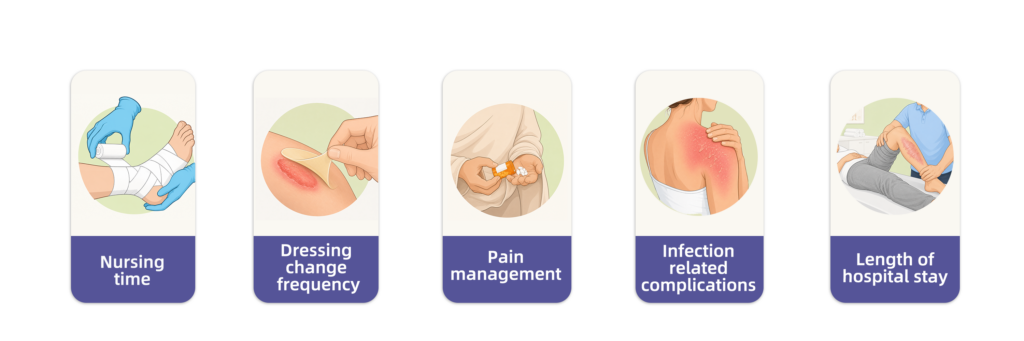
Frequent dressing changes can significantly increase nursing workload and clinical time. Each intervention may also introduce additional discomfort and mechanical stress to the wound, particularly in sensitive or partially healed tissue.
Unstable wound environments, such as those with poor exudate control or moisture imbalance, often require more frequent reassessment and intervention. This can lead to increased use of clinical resources and extended treatment duration.
When complications such as infection occur, the overall cost burden increases further due to prolonged care pathways and additional therapeutic requirements.
For these reasons, burn care cost evaluation must consider the entire treatment process rather than isolated product pricing.
Wound stability as a cost driver
One of the most important but often underestimated factors in burn care cost-efficiency is wound stability.
A stable wound environment reduces the need for frequent intervention, supports predictable healing progression, and minimizes unnecessary disruption to newly formed tissue.
In contrast, unstable wound conditions often lead to repeated dressing changes, increased clinical workload, and prolonged recovery timelines.
As a result, maintaining wound stability is not only a clinical objective, but also a key determinant of overall treatment efficiency.
Efficiency in modern burn wound management
Modern wound care approaches increasingly focus on improving efficiency at the system level rather than optimizing individual components in isolation.
Dressings and wound care materials are therefore evaluated not only by their direct function, but also by their impact on:
- dressing change frequency
- nursing time and workload
- patient comfort and pain reduction
- infection risk management
- overall healing progression stability
Within this framework, advanced wound care solutions are used to support more controlled and efficient treatment pathways.
Supportive role of advanced wound care solutions
In contemporary burn management, different types of dressings are used to support specific functional requirements within the wound environment.
Absorbent systems may help maintain fluid balance and reduce unnecessary intervention frequency. Silicone-based interfaces are commonly used to minimize trauma during dressing changes and improve patient comfort. Antimicrobial technologies may be applied in clinically appropriate cases to support bacterial burden management.
These solutions are not standalone treatments, but components of a broader wound management strategy aimed at improving overall care efficiency.
Conkote provides a range of wound care solutions designed to support these clinical needs across different stages of burn wound management.
Rethinking cost-effectiveness
Cost-effectiveness in burn wound management should not be evaluated solely through unit price comparisons.
Instead, it should be understood as the relationship between clinical performance, treatment efficiency, and overall resource utilization throughout the healing process.
By focusing on wound stability, reducing unnecessary interventions, and supporting controlled healing environments, modern wound care strategies aim to improve both clinical outcomes and operational efficiency.
In this context, value is defined not by the cost of individual dressings, but by their contribution to the overall effectiveness of burn wound management.